|
BBC Poll: Maharaja Ranjit Singh named as greatest leader in world history
 |
| Maharaja Ranjit Singh was the leader of the Sikh Empire, which ruled the northwest Indian subcontinent in the early half of the 19th century. |
- Maharaja Ranjit Singh was fair to members of Faiths
- His reign was truly the Golden Age of Punjab.
- He was a great warrior & an able administrator who unified & modernized NW India.
London, March 05, 2020
NRIpress.club/Ramesh/ A.Gary Singh/Asha Sharma
Greatest Leader of All Times: Under BBC Poll, 5,000 readers, garnering more than 38 per cent of the vote.
BBC Poll Results: |
|
-
The ruler of the vast Sikh empire has been named “Greatest Leader of All Time” in a poll of more than 5,000 readers, garnering more than 38 per cent of the vote. He was praised for presiding over a tolerant, multi-faith empire. Maharaja Ranjit Singh has been named the greatest world leader in BBC World poll.-
-
The second place went to Amílcar Cabral, who fought for African independence, stood second . He is also credited for inspiring many other colonised African countries to rise and fight for independence. Amílcar Cabral was voted the greatest leader by 25 per cent readers.
-
British prime minister Winston Churchill is in the third position with 7 per cent of the vote for his contributions to Britain during world war. American president Abraham Lincoln was voted fourth.
|
 |
Matt Elton, Editor of BBC World Histories Magazine said:
- Ranjit Singh's rule is interpreted as representing ideals of tolerance, freedom and cooperation.
Maharaja Ranjit Singh was one of the most dramatic figures of the 19th century and became a legend in his lifetime. His prime minister was a Dogra Rajput, his finance minister a Brahmin, and his foreign minister a Muslim.
His armies had Sikhs, Hindus and Muslims. His military commanders and ministers were an equally diverse lot. When he decided to modernise his military, he turned to European officers who had fought the Napoleonic wars!
Ranjit Singh was born in Gujranwala, which is now in Pakistan, on November 13, 1780 and passed away on June 27, 1839. Lacking sight in one eye, Ranjit Singh however had the shrewdest of military minds from an early age.
- He married first at the age of 15, and a second marriage to a girl of a prominent Sikh clan helped him climb the ranks of the Sikh chieftains.
1799: Ranjit Singh 18, led his men to a remarkable victory, capturing the city of Lahore, which was then under Afghan rule.
1801: Ranjit Singh had declared himself as the maharaja of Punjab.
- Amritsar, the holiest of Sikh cities and other smaller towns and provinces were captured by his army
- The great Sikh empire disintegrated only after his death in 1839.
- He burst onto the scene in northern India at a time when the British East India Company had a vice-like grip on vast swathes of the subcontinent.
He is also known as the Sher-e-Punjab (Lion of Punjab) for his bravery and is respected as one of the most revered heroes in the Indian history. Under his tenure, the Sikh Empire was very secular since it allowed men from different religions as well, to rise to commanding positions of authority.
In his empire, none of the subjects were discriminated on account of their religion. He never forced Sikhism on non-Sikhs and respected all religions
Singh started drinking at a very young age as drinking alcohol was considered to be a matter of pride at the time.
He had 20 wives. Notables were Rani Mahtab Kaur, Rani Raj Kaur, Ranji Ratan Kaur, Rani Daya Kaur, and Maharani Jind Kaur.
After his death in 1839, The British invaded, the Sikh empire collapsed and instability returned to the region
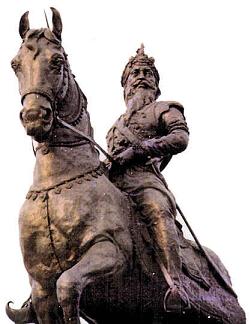
- In 2003, a 22-feet tall bronze statue of Singh was installed in the Parliament of India in his honour.
- In a French town called Saint Tropez, that had military links with Punjab, installed a bronze bust of Ranjit Singh in 2016 -- and Maharaja is revered worldwide.
Donation to Golden Temple:
Maharaja Ranjit Singh donated Rs 16.39 lakh to Golden Temple, Maharaja Kharak Singh & Kanwar Nau Nihal Singh Rs. 9,41,000 and Queens Rs.1,85,000
------------------------
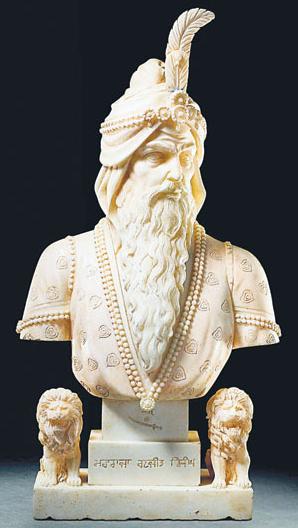
Ranjit Singh’s bust sells for 110,400 pounds
UK, Oct 7, 2008
The milk white sculpture, marble bust auctioned on Monday in London by an international art house for 110,400 pounds. |
| |
Statue of Ranjit Singh unveiled on his 180th death anniversary
LAHORE, June 28, 2019
Nine feet tall statue of the Sikh ruler Maharaja Ranjit Singh was unveiled at the Lahore Fort, at the Mai Jinda’s Haveli, on Thursday evening. The statue, made of cold bronze, shows the regal Sikh emperor sitting on a horse, sword in hand, complete in Sikh attire.
|
| |
Bust
of Maharaja Ranjit Singh, on sale in London on Oct. 09
London, Sep 08, 2008
Satish Mehta
The writer Chirsty Campbell describes Maharaja
Ranjit Singh as “One of the greatest rulers of Northern
India, who built an empire which stretched almost from the Indian
Ocean to the Himalayas. He was also called the Lion of Punjab.
Maharaja Ranjit Singh's reign was also known for all round development,
secular values and patriotic fervour. Keeping all these aspects
in mind, the Amritsar has come up with many such things that reminds
one of Maharaja Ranjit Singh's rule.
The milk white sculpture, marble bust has been priced between
£50,000 and £70,000 and will be be auctioned at the
Bonhams Indian and Islamic sale on October 9 in London. Last year,
a bust of Ranjit Singh's son, Duleep Singh, was sold for £1.7m.
Ranjit Singh crowned himself as the ruler of Punjab and willed
the Koh-i-noor to Jagannath Temple in Orissa while on his deathbed
in 1839. But there was dispute about this last-minute testament,
and in any case it was not executed. On March 29, 1849, the British
flag was hoisted on the citadel of Lahore and the Punjab was formally
proclaimed to be part of the British Empire in India. One of the
terms of the Treaty of Lahore, the legal agreement formalising
this occupation.
The gem called the Koh-i-Noor which was taken from Shah Shuja-ul-Mulk
by Maharajah Ranjit Singh shall be surrendered by the Maharajah
of Lahore to the Queen of England.
Maharaja Ranjit Singh suddenly died of a paralytic stoke in June
1839. He was succeeded by his imbecile son, Kharak Singh. On November
5, 1840, Kharak Singh die and the reign of his capable son Nao
Nihal Singh also ended the same day while returning home from
the cemetery after performing funeral rites of his father by the
fall of an archway of the Lahore Fort. The following years witnessed
intrigue and murders. The English were closely watching the happenings
in the Punjab and they finally declared war is December, 1845
which ended in February 1846. Sikh army was defeated and Peace
Treaty was concluded between Maharaja Dalip Singh, a minor son
of Maharaja Ranjit Singh and the East Indian company. This peace
treaty did not last long and second Anglo-Sikh war was fought
in 1848-49. Finally the Sikh army was defeated and Punjab was
annexed. The Maharaja Dalip Singh was pensioned off, all state
property confiscated to the company, the celebrated diamond, the
Koh-i-Noor surrended to the Queen of England on 24th March, 1849.
This is how the Koh-i-Noor passing through many hands finally
reached England.
The Governor-General in charge for the ratification of this
treaty was Lord Dalhousie. More than anyone, Dalhousie was responsible
for the British acquiring the Koh-i-Noor, in which he continued
to show great interest for the rest of his life. Dalhousie's work
in India was sometimes controversial, and his acquisition of the
diamond, amongst many other things, was criticised by some contemporary
British commentators. Although some suggested that the diamond
should have been presented as a gift to the Queen, it is clear
that Dalhousie felt strongly that the stone was a spoil of war,
and treated it accordingly. Writing to his friend Sir George Cooper
in August of 1849, he stated this:
The Court [of the East India Company] you say, are ruffled by
my having caused the Maharajah to cede to the Queen the Koh-i-noor;
while the 'Daily News' and my Lord Ellenborough [Governor-General
of India, 1841-44] are indignant because I did not confiscate
everything to her Majesty... [My] motive was simply this: that
it was more for the honour of the Queen that the Koh-i-noor should
be surrendered directly from the hand of the conquered prince
into the hands of the sovereign who was his conqueror, than it
should be presented to her as a gift -- which is always a favour
-- by any joint-stock company among her subjects. So the Court
ought to feel.
Dalhousie arranged that the diamond should be presented by Maharaja
Ranjit Singh's successor, Duleep Singh, to Queen Victoria in 1851.
Duleep travelled to the United Kingdom to do this. The presentation
of the Koh-i-Noor to Queen Victoria was the latest in the long
history of transfers of the stone as a spoil of war. |
| |
Maharaja Ranjit Singh, the Sikh empire founder who put the 'Gold' in Golden Temple
aharaja Ranjit Singh is well-known for the golden beautification of the Harmandir Sahib Gurdwara in Amritsar, famously known as the Golden Temple.
|

|