|
||
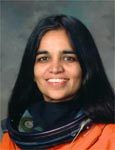
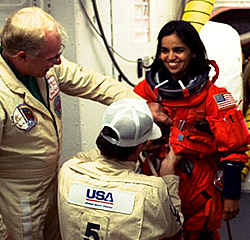
| NRI, Astronaut Dr. Kalpana Chawla- died | ||
|
 |
|


-
New York road to be named after Kalpana Chawla
New York, November 22, 2003, A road in New York is being named "Kalpana Chawla Way" after the Indian American astronaut who died when the space shuttle Columbia disintegrated over the Texas sky in February.The Community Board No.3 in Queens voted a motion to rename a part of 74th Street in Jackson Heights "Kalpana Chawla Way"."The motion will now go to the City Council in the form of a bill, and passage by the council is a mere formality. -
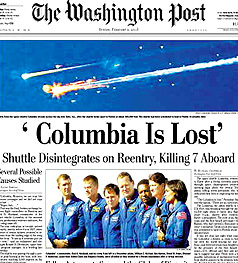
Astronaut Kalpana Chawla (Phd.) and six others burst into flames minutes before landing
Click here:
 The
STS-107 crewmembers, shown here on launch day -- Jan. 16, 2003 --
were lost Feb. 1.
The
STS-107 crewmembers, shown here on launch day -- Jan. 16, 2003 --
were lost Feb. 1.
Space
Research and you
The space shuttle Columbia disintegrated over the state of Texas today, minutes before its scheduled landing in Florida, killing all seven astronauts on board. Six of them were Americans, including the Indian American, Kalpana Chawla and one Israeli air force officer. Calling it as indeed a ``tragic day'' for the NASA family, the top administrator of the agency, Sean O'Keefe, told a press briefing that the terrible tragedy was not caused ``from the ground''. A full investigative process has been initiated, including the setting up of a Mishap Investigation Board. The last communication from the shuttle was ``garbled''. First efforts are on to study the circumstances leading to the disaster. Soon after the accident, Mr. O'Keefe said that he got in touch with the President, George W. Bush, who immediately offered full and immediate support. The President is said to have spoken to the family members of the astronauts. NASA is cautioning people against going near or touching debris from the shuttle that is believed to be spread over an area of about 120 miles and perhaps across several states. At the speed and height of the disintegration, no one held out any hope of survivors on board the shuttle. In its final stages it was at a height of 207,000 feet and travelling at a speed of 12,500 miles per hour. Senior officials of the Bush administration said that there was no immediate information that could suggest that terrorism was a factor in the tragedy that hit Columbia. ``There is no information at this time that this was a terrorist incident. Obviously the investigation is just beginning, but this is the information we have now'', said a spokesman for the newly-created Homeland Security Department. Unnamed senior law enforcement officials have also been quoted as saying that there was nothing ``troubling'' by way of intelligence about this particular flight, which included an Israeli astronaut. That being the case terrorism was being ruled out. The Federal Bureau of Investigation is yet to be formally brought into the picture. Security was extraordinarily tight because of the presence of the Israeli astronaut, Ilan Ramon, the first person from the Jewish state to fly into space. Some feared that the presence of Mr. Ramon would make the shuttle a terrorist target. Apart from Ms. Chawla, the only other person in the shuttle who had been in space before was the commander, Rick Husband — the rest of the five were first-timers. Mr. Bush, who was first informed of the tragedy by his Chief of Staff, Andrew Card, returned to the White House early afternoon to keep track of the developments. The President is expected to talk to the Prime Minister of Israel, Ariel Sharon, to express condolences for the loss of Mr. Ramon. Senior officials of the administration, including the Vice President, the Secretaries of State and Defence, the National Security Adviser and the Chairman of the Joint Chiefs of Staff were also immediately notified of the accident. The President is expected to address the nation later. The nation is already in a state of mourning. Flags are flying at half-staff at the White House, the Capitol Hill and the Kennedy Space Center. The 16-day shuttle flight was due to end in Florida at 9:16 a.m. Eastern Time. But some 16 minutes before this was to happen Mission Control lost contact with the spacecraft and soon thereafter television footage showed signs of the craft disintegrating. The speed and distance from the ground are two major things that are being taken into account by experts as they have initially ruled out terrorism — the shuttle was out of range for a surface-to-air missile, a senior official has been quoted as saying. But what is being paid close attention to in the initial hours of the tragedy is what took place when the shuttle lifted off on January 16 — a piece of insulating foam on the external fuel tank cane off and is said to have hit the left wing of the craft. At the time engineers felt that this was of minor consequence and posed no danger to the mission. Also under scrutiny is the age of the shuttle. The Columbia is NASA's oldest shuttle and the last flight was the 28th for the craft. But what has to be kept in mind is that in the four decades-plus of human space flight, there has not been an accident during descent or landing. In 1986 the space shuttle Challenger exploded barely one minute into lift-off. Ironically only this past week NASA observed the anniversary of the earlier twin tragedies — the Challenger explosion of January 28,1986 that killed seven astronauts and the fire aboard an Apollo spacecraft on January 27,1967 that killed three.Kalpana Chawla, who was killed in the Columbia space shuttle tragedy along with six others, had done India proud when she embarked on her first space mission on November 19, 1997. The Karnal-born Chawla, first Indian American astronaut, began her career at the Ames Research Center at NASA in 1988. A graduate in Aeronautical Engineering from the Punjab Engineering College she began work at the Ames in the area of fluid dynamics. She completed her Masters from the University of Texas in 1984, earned a doctorate from the University of Colorado. Following her successful tenure at the Ames, Ms. Chawla joined in 1993 the Overset Methods Inc. in California as its vice-president and research scientist in charge of simulating various body functions for future space missions. The NASA selected Ms. Chawla as an astronaut candidate in 1994 and she joined the 15th group of astronauts in March 1995. After an year of training and evaluation, Ms. Chawla was assigned as a crew representative to work on technical issues for NASA's Astronaut Office Extra Vehicular Activities, Robotics, dealing in space walks. She was instrumental in the testing of space control software in the Shuttle Avionics Integration Laboratory. Ms. Chawla's received recognition here and was assigned as Mission Specialist and Prime Robotic Arm Operator on the STS-87 and was involved in the manual capture of an orbiting satellite.
PERSONAL DATA: Born in Karnal, India. Kalpana Chawla enjoys flying, hiking, back-packing, and reading. She holds Certificated Flight Instructor's license with airplane and glider ratings, Commercial Pilot's licenses for single- and multi-engine land and seaplanes, and Gliders, and instrument rating for airplanes. She enjoys flying aerobatics and tail-wheel airplanes. EDUCATION: Graduated from Tagore School, Karnal, India, in 1976. Bachelor of science degree in aeronautical engineering from Punjab Engineering College, India, 1982. Master of science degree in aerospace engineering from University of Texas, 1984. Doctorate of philosophy in aerospace engineering from University of Colorado, 1988. EXPERIENCE: In 1988, Kalpana Chawla started work at NASA Ames Research Center in the area of powered-lift computational fluid dynamics. Her research concentrated on simulation of complex air flows encountered around aircraft such as the Harrier in "ground-effect." Following completion of this project she supported research in mapping of flow solvers to parallel computers, and testing of these solvers by carrying out powered lift computations. In 1993 Kalpana Chawla joined Overset Methods Inc., Los Altos, California, as Vice President and Research Scientist to form a team with other researchers specializing in simulation of moving multiple body problems. She was responsible for development and implementation of efficient techniques to perform aerodynamic optimization. Results of various projects that Kalpana Chawla participated in are documented in technical conference papers and journals. NASA EXPERIENCE: Selected by NASA in December 1994, Kalpana Chawla reported to the Johnson Space Center in March 1995 as an astronaut candidate in the 15th Group of Astronauts. After completing a year of training and evaluation, she was assigned as crew representative to work technical issues for the Astronaut Office EVA/Robotics and Computer Branches. Her assignments included work on development of Robotic Situational Awareness Displays and testing space shuttle control software in the Shuttle Avionics Integration Laboratory. In November, 1996, Kalpana Chawla was assigned as mission specialist and prime robotic arm operator on STS-87 (November 19 to December 5, 1997). STS-87 was the fourth U.S Microgravity Payload flight and focused on experiments designed to study how the weightless environment of space affects various physical processes, and on observations of the Sun's outer atmospheric layers. Two members of the crew performed an EVA (spacewalk) which featured the manual capture of a Spartan satellite, in addition to testing EVA tools and procedures for future Space Station assembly. In completing her first mission, Kalpana Chawla traveled 6.5 million miles in 252 orbits of the Earth and logged 376 hours and 34 minutes in space. In January, 1998, Kalpana Chawla was assigned as crew representative for shuttle and station flight crew equipment. Subsequently, she was assigned as the lead for Astronaut Office’s Crew Systems and Habitability section. She is currently assigned to the crew of STS-107 scheduled for launch in 2003.
-
Preflight Interview: Kalpana Chawla
The STS-107 Crew Interview with Kalpana Chawla, mission specialist.
For starters, can you please give me a brief overview of what the crew is going to do on the mission? What's it all about? And, explain the goals of the mission.
As you know, ours is a research science mission. And, it's dual shift to top that. It's the first flight of the Research Double Module from Spacehab. We'll be conducting basically 16 days' worth of microgravity research in two shifts a day. So, that's 16 hours plus of work every day. We have experiments from lots of different areas. There are experiments from Earth sciences, physical sciences, and life sciences. And, in all these three areas, there are a number of very interesting experiments. For example in Earth sciences, we have a payload from Israel, which is the MEIDEX (Mediterranean Dust Experiment from Israel) where we are going to be studying aerosols and dust particles over Earth. Mostly over the Mediterranean, so that there can be some validation done of ground-based studies at the same times. But, if there's a dust storm during our flight, any place on Earth, then there would be a request made to do MEIDEX experiments on orbit. And, the purpose is so that we can do climactic studies better than we can right now. So, in the Earth sciences area, there's also another experiment called SOLSE. SOLSE is going to study the ozone distribution in the vertical over the Earth's atmosphere. As you know, the ozone distribution is very closely tied to the health of our planet, so it's very crucial to understand if it changes over time, and how much it changes, and what the causes are. Along with this, there is another experiment, which is in our payload bay, which is going to measure the solar constant. And, again, the idea is to relate that to the study of climate in Earth. That's probably [the] bulk of the experiments which are tied to Earth sciences or climactic studies. The second area, which is very exciting to me personally (because it ties to some of my background), is physical sciences. In there, we have studies from a wide area of research in materials. For example, crystal growth under the umbrella of Zeolite Crystal Growth Experiment. There's another one called Mechanics of Granular Materials, where we're trying to study how liquefaction of sands in coastal areas can have an impact on buildings and structures, especially during earthquakes. In the same area, we have [a] combustion module that we are carrying on board. It's a very large facility. And, in this particular module, we're going to carry out three different experiments to study flames of different varieties. And, we can talk about that at length a bit later. So this is the physical sciences area. And, there's tons more experiments. Finally, a lot of study's being done in the third area, the life sciences area. There are experiments from Johnson Space Center, from the European Space Agency and literally from tens of thousands of researchers and students across the world. In this latter category, we have experiments in protein crystal growth. In protein crystal growth, all these different researchers, they are trying to aim at growing bigger protein crystals so that you can characterize what a particular protein looks like. And, once you know that, you can have better ways of coming up with countermeasures for the bad proteins they are tied to, for example, some disease. We have four different lockers in which we have anywhere from 200 to a thousand experiments within each locker. And, within each locker, for example, 10 of the experiments might be sponsored by one pharmaceutical company. Another 10 might be sponsored by another research organization. And, so on. So, it's really totally incredible the amount of participation that's there in the protein crystal growth experiments in the life sciences area. The other experiments are trying to get a better handle of human physiology in space by studying either humans (four of our crewmembers are actually going to be participating in detailed measurements of certain aspects of human biology) or, in some cases, we are studying some other life forms to understand [the] effect of microgravity on those life forms. And, then later try to determine how these are tied to human physiology. Besides these three very wide areas, there are a lot of experiments which are in the education area. Students are flying these experiments. And, finally, I'd just like to add, there are a few experiments which are tied to Space Station so that these technologies can be used on Space Station. We are going to fly them on our flight, and later they can be used on the Space Station.
And, there are a multitude of experiments. And, you've touched on some of them. And most of these experiments have goals or purposes. But, is there, in a nutshell, an overall goal of the mission for NASA? Why is NASA flying the mission? Is there an overall goal?
The overall objective of flying all of these experiments is basically to, in some cases, simply to understand. In some cases, to better understand processes. Be it physical processes; be it processes in the area of Earth sciences (how climate works). Be it life sciences, where we are trying to figure out proteins, for example which are tied to human life so closely - what their structure is - so we can come up with a better idea of how the proteins work, period. And then, figure out how they interact. So, the overall objective, in a nutshell, it would be fair to say is: to try to understand or better understand physical processes on Earth, be they in the area of life sciences or materials or climate.
Can you give some insight into why we need to go to space to conduct some of the same research that's being conducted on Earth? Basically, what importance does microgravity have on these experiments, and what advantages does microgravity offer for them?
Sure. Really, we go to space for two reasons. Sometimes we get [a] better advantage because there's [a] microgravity environment. In that case, we are basically trying to do a few things. For example there are certain things on Earth which are very complex, very closely tied processes. For example turbulence on Earth is very closely tied to soot formation in flames. Since these two things are so closely tied and they are both very complex things, it's very hard on Earth to decouple them to understand why is this thing happening? Is this because of turbulence? Is this because of soot formation? So, we try to go to space so we can decouple the effect of gravity out of some of the equations. So the equation set or the governing principles for a process can be made simpler. So, we can say: This will process. In the absence of gravity, this is how it works. And then, we can try to understand: Okay, if we add gravity to it, that's when these other things happen. A simple example: there might be, for example, on Earth when you are mixing two things (like oil and vinegar) and they separate. So, if you're trying to make a material out of these two things, you are forever having to indulge in a very active process of mixing these together. And, it causes a new physics to happen because you are mixing these two things. So, there's a swirling motion involved now. How does that impact the upcoming material? You go to space, and the two things are just dispersed into each other. And so, the effect of gravity or the absence of gravity then helps to make the process simpler and, therefore, helps us understand the physics better. In the same vein, the second thing is that crystals, which is a very important field that we have carried into microgravity, in the absence of gravity, you can grow bigger crystals. It does not matter what kind of crystals they are; you can simply grow them bigger. If you can grow them bigger, it helps you characterize the behavior. Not really the behavior. The structure of these crystals. In materials, it's very important to know what the structure of this crystal is so you can figure out when it mixes with something else what's going to happen. In life sciences, in protein crystals, if you can understand what the structure of this crystal is, that leads you to forming the key on how to make this particular protein mate with another protein. So those are the areas where you can help remove gravity and then do better in microgravity. The second reason, which is really totally different, is that in space, you are going to go study, for example, the one experiment I mentioned, the ozone distribution. This is just a better vantage point. You are above the Earth's atmosphere. You are trying to look at the limb, and so you can see what's going on in ozone distribution in the vertical layer of our atmosphere. We are not doing astronomy experiments. But, you've heard, there are lots of space shuttle missions dedicated to doing astronomy experiments. And, once again, you are going to space not necessarily for microgravity but it gives you a better vantage point, better seeing, for example.
Some people may be expecting the research on this mission to yield immediate solutions to problems or to theories or whatever. But that's not necessarily [the] case. Can you explain and describe, for someone who's not a scientist and not involved in scientific research, what the place of research is and the scientific problem-solving process or theory-proving process?
It's actually quite surprising that generally, when we are carrying out research, how we do it in a very formed manner where we know in stage one we are going to study certain parameters and their effect on certain processes. In doing so, sometimes we validate our assumptions, and sometimes we learn new lessons. And, our assumptions, we find out, were not correct. So, we go on to the next step and so on. In microgravity research, [a] lot of times in the early Eighties, for example, the assumptions we had made were not all true. Sometimes we thought simply going to microgravity would allow us to make better materials because of the absence of buoyancy-driven connection. But, we found in space, there is another type of connection, which starts to play a more dominant role. So, we are learning. It does not mean that we don't go to the third step, which is, "Okay, now. We know this is the reason this thing is not working in space. How do we overcome that?" Then, we try to find out how to overcome that. And, so the real process happens in stages. You go through the first stage, and the second stage, and so on. It's not really true that all of the experiments have this tough path at this stage in the ballgame of spaceflight research because as you know, this particular mission is the first commercial flight of Double Research Module. So, there are a lot of experiments which are actually sponsored by commercial companies which, given the benefit of past research, are now looking for quicker return on what they are doing. Some areas that I could mention along these lines are, for example, the Zeolite Crystal Growth payload, where the investigators and the researchers are trying to come up with materials, these are advanced materials which can be used to, for example, store hydrogen at room temperature. Why would you want to do that? So that you can use hydrogen as a fuel as opposed to using things that we use as fuel today for street vehicles. It's very hard to store hydrogen at room temperatures. But, these advanced materials have these capabilities that hydrogen just stays mated to the material. There are a number of materials in this category. For example, better dye retention on pictures - as in photography or newspapers. The print being held to the paper with the dye better than it does today, so that it stays there over a longer period of time. All of these experiments in the zeolite area are actually sponsored by commercial partners. And, they are actually looking for a quick return so that, when these materials are made they bring them back, look at the crystals and then try to figure out which particular material could have been added in the higher proportion to get the effect that they were really seeking. Likewise in the protein crystal area, the pharmaceutical companies that are participating are looking for quicker returns than the conventional way we look at science, which is sometimes just thinking it's for better understanding. So I would say we have experiments in both varieties at this stage in spaceflight research due to the past benefits of all the research that has been done. Be it, for example, the Zeolite crystals or the protein crystals for pharmaceutical companies.
You mentioned the dual work shift. Can you talk a little bit about what that is? And, why it's necessary on this mission?
We are a dual-shift mission because the extent of science, the experiments we are carrying, is just very, very large. There is simply no way to carry out that kind of science with just one shift. You might say, if we have seven people on one shift, they could just divvy up the experiments and, hence, you should be able to do the same number of things. The issue is that on our Orbiter, there are lots of attitude requirements. The Orbiter should be in a certain attitude to do, for example, the ozone measurements. In a different attitude to do, for example, the dust measurements. In a free-drift attitude, meaning that no jets should be firing and it's just drifting (hence the word free drift) to do some of our very microgravity-sensitive experiments. For example, one of the combustion module experiments needs a very quiescent environment. So, because of these very extensive requirements on what sort of attitude the Orbiter should be in, and what kind of microgravity environment is required, you sort of need to take advantage of the whole day. And it really helps to use the crew much more efficiently by doing that.
The research on this mission spans a wide range of origins. It originates from various parts of the world. Some of those places the crew has visited to familiarize yourselves with the experiments. Can you give us some insight into your thoughts about what it's like to be on a mission like this, that's not only fostering a continued awareness of other parts of the world, but helping those parts of the world maybe solve some of the problems that they may be encountering and the benefits they maybe could reap from this mission?
Yeah, it's indeed true that on our mission there are experiments from all over. It really surprises me even now that when we look at for a particular experiment or payload on our flight, how many different researchers are participating to get things done. I think it's the nature of world economics at present where there are extensive collaborations amongst partner countries to come up with better technologies. And they do share these technologies with each other. For example in the protein crystal growth experiment the number of researchers is literally in thousands. And, they are collaborating with each other, with their ideas on how better to do these experiments. And the benefits in an area like this are really to all of the humanity. Because if you find out something better in that area, that's obviously going to benefit us all. Another area which really stands out, we have some experiments which sit in the payload bay which are looking at technologies for heat rejection for spacecraft. You know we fly satellites in space vehicles, and they produce heat. And, one of the big technical impediments out there is how to reject heat and stay healthy in space. So there are three different ideas on technologies on how best to reject heat from three different countries in Europe. The really good thing is: when the results come back, you can really say how these technologies work, which one is better for certain areas or certain environments in space. For example, you are always looking at the Sun versus always looking at Earth. But in the end, the benefits are really had by all.
And personally, how does it make you feel to have a part in something that is, in a way, advancing or bringing the global community even closer? I mean, it was this far away--
Right.
--but now it's still coming closer together. Personally, how do you feel about that?
It is very gratifying and humbling. And, it really is incredible to see that there are all these countries that are participating in this research. And, basically, they have one goal, which is to better understand these processes and then be able to use the benefits that come out of them. What's really interesting in a scientific community is when you go to one place and you know about some of the rifts some of these people might be having. But in this room, these six scientists from six different countries are together. And, they are trying to do something which is totally mind-boggling. And, to sit with them and talk to them and understand, you know, their fears and concerns on if their assumptions are wrong; but if everything that they've done is right and some big benefit can come out of it, it's just tremendously gratifying to have been there and be a part of that process and to help them carry out their experiments in space.
There's obviously no rendezvous and no docking in this mission or undocking. But you still have to get to space and then return to Earth. And, there are processes for doing that. Can you explain what's going to go on on the way up? What are the duties? What will you be doing? What's the process? And, also, for the return trip to Earth. If you can just kind of nutshell those two processes.
I am very excited to serve as the Flight Engineer on the flight. On ascent the flight deck crew is basically monitoring the systems. Flight Engineer's job is to make sure all systems are working nominally by glancing at the different meters and displays in an organized fashion and to diagnose malfunctions, if any, respond to those malfunctions, and help the Commander and Pilot execute their procedures if there is a malfunction. And then, to sort of have a big picture: If there's a malfunction, how does it impact us? A minute from now? Five minutes from now? And, so on. Before we have main engine cutoff versus after we have main engine cutoff. So for ascent and entry, basically that's the role I serve in. On orbit as Flight Engineer we get daily uplinks, in case of systems not working nominally if we have to deorbit then what particular information bits and pieces we can use to determine at what time we should do the deorbit burn, which landing sites are available to us, etc. We get this information every day. So, we process it on board so we know, at all times, that these are the paths we have open to us. As a crew, we spend a fair amount of time in our ascent and entry simulators training for these sort of tasks. Besides the Flight Engineer duties as you know, this mission is dedicated to research science. And, all of us - all seven of us - basically are very busy and timelined to the full extent to carry out research every day. So basically during our wake-up hours, we are busy doing the experiments that we are timelined to do. So day after day, different experiments; that's what we do.
And that starts shortly after you guys reach orbit. Can you tell us what the process of activating experiments, when that starts? Activating the modules, when that starts? And explain what you and your crewmates will be doing at that point in the flight.
The main engines shut off just 8½ minutes after launch. And after that, basically the whole crew is working to get the Orbiter ready for orbit. The flight deck crew is busy working to target the OMS burn we do to get to orbit. And the middeck crew is busy trying to get switches and systems in [the] right order so that in that upcoming phase of flight, everything is [as] it's supposed to be. About two hours into our mission, Laurel Clark and Ilan Ramon, my crewmates, are ready to open the hatch to Spacehab and start activating the Spacehab systems. Both of those crewmembers - Ilan and Laurel - are from the Red Shift. Red shift is the same shift I am on and Commander Rick Husband is on. Four of us will work the longer day when we get on orbit. We are the wake-up crew, you might say. The other shift, the Blue Shift - which is our Pilot Willie McCool, David Brown, Mission Specialist, and Mike Anderson, who's our Payload Commander - three of them basically, after helping out with trying to get the Orbiter in [the] right configuration for the early period of the mission, we have to make sure they can go to sleep so that when we go to sleep, it's time for them to wake up. We basically share the same sleep stations, so we have to get them up so we can go to sleep. And then they can take the helm of the ship and start working the science experiments, etc. So after two hours, we basically start to think that four of us, on the Red Shift, really need to get Spacehab and the Orbiter working for rest of the mission. Willie McCool from the Blue Shift would help set up our laptop network in that early period. Dave Brown would help activate the FREESTAR experiment, which is back in the payload bay. Ilan and Laurel, as I mentioned, activate Spacehab. I work with the Commander for the first half-hour or so of that later period to get our computers (the Orbiter computers) in the right configuration for on-orbit operations. And then shortly thereafter I work with Laurel and Ilan. And, my job is to activate a number of experiments, which are in the Research Double Module. Shortly thereafter, three of us (Ilan, myself, and Laurel), we are working on different parts of Spacehab, setting up equipment for experiments that we're going to be doing. I'm doing the video setup with a number of boxes, so we can give video downlink to ground for the experiments that do need to send video downlink. We start to deploy equipment in Spacehab. Our computers, cameras, equipment that we need for housekeeping, our Flight Data File (the procedure books that we need to use to carry out any of the procedures). So, the first day is very busy, basically, in getting experiments started which are mostly passive. Where we just have to turn them on, or some experiments where we need to do a setup so we can perform them in the upcoming hours. And then, all of the housekeeping tasks- be it deploying the laptops, the network of laptops, the video equipment, and so on.
Talk a little bit about some of the operation and the purpose of some of the specific experiments that you're going to be working with. We touched a little bit on MEIDEX before (the Mediterranean Israeli Test Experiment). Can you give us a little bit of insight into the operation of the process? How it operates and a little bit more about what it's for and what it does.
The MEIDEX experiment is sponsored by Israel, as you know, is basically looking at aerosols and dust particles in Earth's atmosphere. It does that by using special cameras, which are mounted in the payload bay. For part of the mission, our goal is to look at these aerosols and dust particles in conjunction with ground. So, people on ground can also look at [the] same dust particles and aerosols so we can validate the information from space with information from ground. We would also be looking at dust particles and aerosols during [the] rest of our mission when ground cannot necessarily look at these particles. And at that time, we can use the knowledge that we would have gained by having done the validation for simultaneous studies. The main purpose for studying aerosols and dust particles is because they play a big role in how climate works. And climate is a very global topic. It's not: if climate in U.S. is bad, it doesn't really matter because it just affects us and nobody else. Bad climate or bad emissions of particles anywhere on Earth would ultimately impact us all. And in fact the impact happens in a very short duration of time. It's not something we can ignore by saying, "Oh, this is a problem that's not worthy of our immediate attention." Within the MEIDEX experiment, perhaps one of the intriguing and very captivating studies is study of sprites. Which is, when there are lightning storms we've observed with certain aircraft that there's upward emitting lightning. Long time ago, if people were flying an aircraft and they observed this, nobody would want to believe. It's, you know, you are [imagining] these things. But, over time, people have come to understand that this is real. Though we don't really understand how it works, the physics behind it. This particular experiment, study of sprites, when there are lightning storms, has captivated the imagination of tens of researchers on ground. So, even though it's a secondary experiment on MEIDEX a lot of researchers on ground have found out about it and now they are participating with ground studies simultaneous with the space shuttle studies. Again to correlate data. So, if you see it from above, what information [do] you get? And, the same information and looked from below means what? For better understanding of how it might work. Tied with sprites [are] blue jets, a similar phenomenon related to lightning. So, there are all these very neat, interesting concepts in climate which are secondary objectives which a lot of researchers are now participating in. Our on-orbit operations basically mean that we give commands to the cameras, which are in the payload bay. Using computers, we type out the commands and direct these cameras to look in the right region. The space shuttle, by that time, is already in [the] correct attitude. It's looking at Earth at places where it ought to be looking at for studying dust particles, aerosols, or sprites, which would mean a slightly different attitude. And we would collect video data from the cameras and send it to ground for analysis, real time. Which is delayed by about a day. And, also later after the mission. In the MEIDEX experiment, there are ground studies planned where the Tel Aviv University in conjunction with a number of other research organizations is planning to fly small aircraft, which are fully instrumented; and they will fly these pre-designed trajectories through the region where there is dust and aerosols. For example, going in one direction and then the other direction for specified durations of time with the specified increments in altitude so that they have a very good idea of how these things are distributed. Of course, something like that on Earth, they are unable to do everywhere on Earth. So, the region where this is to be done is very limited. The space shuttle-based studies will definitely include the regions where ground studies are being done so we can have a good correlation. But, the space shuttle will also study other regions on Earth where there is dust. For example, if there's a big dust storm during our mission, then more than likely we would be asked to do MEIDEX studies for that. It's quite probable that the dust storm is over a region where the aircraft studies cannot be done, because it's very remote. For that particular case, the idea is to use the knowledge gained from the region where we have the ability to validate space-based study with Earth-based aircraft study. So, both of these aspects are going to be carried out.
Another experiment is the CM-2, the Combustion Module-2. Can you explain just what it is? Not so much about the experiments just yet. What is the CM-2?
CM-2 is Combustion Module. It's basically two very big facilities. You might say they are [the] size of a very large family-size refrigerator. And we are going to carry three different experiments. They are all flames-related experiments. One of these is to understand how soot forms. Soot is a bad thing on Earth. A lot of people die from soot inhalation. The second one is to understand the leanest mixture settings at which we can burn a fuel, and this is to understand fuel efficiency better. And, [the] third one is how to extinguish fires using nontoxic materials. Because right now, most of our fire suppression technologies use materials which are not very good for us. So, we get rid of the fire, then we are unable to enter the same area for a while. So, this third experiment actually uses water droplets to extinguish fires. And, it could have potential uses later on - on Earth, of course, and also in space; for example, the space station to take care of any problems that might arise.
Let's talk a little bit about the operation of those experiments. Earlier you were talking about the mist experiment. How does that operate? What will the crew be doing during that experiment?
All three combustion module experiments are very hands-on and obviously a lot of fun for [the] operator to work with. Let's use, for example, the MIST experiment. What we do in this telephone booth-size or family refrigerator-size module that we have: we can insert the experiment, which is sort of like the size of a big microwave oven, inside this module. The experiment itself has hardware where there is a little camera to monitor what's going on; a little capacitor, which is charged with water so it can spray water droplets; it can inject them at different sizes; we can control, to a degree, the speed at which the droplets are injected. So, the experiment itself is a self-contained unit. We take it out from the storage location, insert it inside the big module. There are some large cables that we hook up. A big cable to supply power to the experiment, a cable for data so that data that is being collected can be brought out via a laptop and then sent to ground for real-time analysis (in this case), and also video information is coming out from the experiment which is again rerouted to us and to ground for real-time recording and real-time downlink. We do the experiment setup a few times. We insert it in the module. We might have to do it again to, for example, change the little unit which controls the size of droplets. But once it's inside, we can carry on, for example, 12 different studies where we are looking at the effect of different parameters on the flame. So, part of the experiment will help generate a flame. We have a little laptop, using which we control when things happen. The flame gets generated, and then the water particles or the water mist gets injected onto the flame. All of this is captured on video and data, which is recorded and seen real time and downlinked real time. After the experiment is done, a little later we'll start with the second parametric study where we are varying something else and carry on the same test run yet again. So, to give you a certain idea: In MIST, for example, we do 36 different parametric studies, which basically are done one after another. Some of these are, actually a large number of these are, commanded by ground. After we get the setup done [the] first time and make sure that the first study is correct and things are now going smoothly, then ground can take over and do rest of the studies.
And, another experiment to be conducted within that module is SOFBALL or Structures of Flame Balls at Low Lewis Numbers. Can you tell us a little bit about the operation of that?
SOFBALL is actually a very exciting study. And, it perhaps is one which has its basis more in theory than the other experiments. So, those people who are into theoretical chemistry would love the genesis of this particular experiment. Long time ago, there's this Russian scientist, Zeldovich and he figured out, just by looking at the equations, [that] if you did not have gravity, then you should be able to get flame balls rather than regular flames. And, this would happen if you are burning a mixture at its leanest setting. Meaning the fuel composition is very, very low. When we say a mixture is rich, we mean there's lot of fuel. Leaner setting meaning: the smallest amount of fuel that will support combustion. So, he predicted that, and that was the end of story. It's just written in books. And then, lo and behold, there's this professor at University of California, Dr. Ronney, and he has been involved with combustion studies for a while and does drop tower tests. Where you come up with little combustion experiments which are dropped in these big towers that you might have heard of and then you get less than a second worth of science study out of these. And, it's all videotaped. And, you break it, frame by frame, and see what happened. And in one of these studies, he discovered there were flame balls. And, he was just totally amazed that much has happened in other areas where Einstein, for example, predicted bending of light and much, much later it was validated. Similarly this was predicted lots of years before [it was] seen by Ronney, and then he came up with the idea of validating it in space. With the potential benefit, again, you should always be tied to something in real life, that if we can understand that flame balls really work, then this can help us better understand combustion modeling. Combustion modeling is one of the toughest fields out there where we are still trying to figure out, based on just theory and equations, that: If I solve this problem on computer, can I get the real result? And, of course, any time we can do that, we save a lot of resources, as has been shown, for example, in the area of aircraft design. You know, commercial companies routinely now use aerodynamics modeling to come up with aircraft design. In the case of combustion modeling, we have been really lacking because it's a very complex field, and we are unable to tie all the things together. So, if we can understand this yet one simple component of this whole equation and see how it works, it helps us get one step further. So, as I mentioned, this experiment has flown once before. A lot of very interesting parametric studies are planned for our flight because Professor Ronney's better able to predict that these flame balls should be able to last for a matter of hours. And, the Orbiter will be in free drift during those times to minimize any disturbances from jet firings, for example. And then, collect video data, temperature data, and tie it to the modeling equations. I think this should prove to be very interesting.
The third experiment within that module that you've touched on already: LSP Laminar Soot Process. Can you briefly explain the operation of that experiment?
Laminar Soot experiment, much like the MIST and SOFBALL experiment, has its own experiment module that, as far as we are concerned, will integrate it- the microwave oven-size module- inside the bigger refrigerator-size module, connect the cables so that commands can flow in, data can come out, power can go in, etc. Once we've done that, the experiment is basically looking at flames and looking at the limit of flame where soot is formed. Soot is collected in these collection banks, they call, and temperature data is collected real time. All of this is to be looked at later on based on the assumptions the scientists have. By having these 12 parameters, we'll be able to tell how this thing works. Why are we studying soot in space? Or what's the benefit? Or, why is there a need to do this in space? It's because, on Earth, soot is generally produced by turbulent flames. Turbulence and soot, which is combustion chemistry, are two of the most complicated fields. It's almost impossible to solve the equations or model them so that you have both of these players in. It would be really very nice if one of these can be chucked out. Well, if you throw away soot, then you cannot study soot. If you throw away turbulence, then how do you study soot? Because turbulence is the process behind it. We do know, though, that laminar diffusion flames, which are very similar to turbulent flames (they mimic all of their characteristics), also cause soot. But, where do we generate laminar diffusion place, flames? Only place to do that is in microgravity. Hence, going to space. So, you go to space, use microgravity to dissociate turbulence from the equation so that you just have laminar diffusion flames, which mimic everything that the turbulent flame was doing yet does not have the complicated math behind it, yet generates soot. So, that's the reason of going to space with this experiment. So, like I said before, the potential is twofold. One, of course, soot is bad. It would really help to figure out what generates it and how to eliminate. And second, besides that, any time we can model the governing processes better than we can do today, we are better off. Because now we know how this works. And, we can know the answer in advance rather than doing the experiment and then figuring out, "Oh, this is what happened."
You've touched on the MGM experiment before, the Mechanics of Granular Materials. Can you briefly explain how that experiment will be operated? What's the operation procedure?
The Mechanics of Granular experiment is housed in the Spacehab Double Research module. It sits kind of at the aft wall, has one big double locker - a locker is size of a microwave, you might say - has big double locker associated with it. What we have there is a test cell. The test cell is about 18 inches long. It's triangular in its cross-section. You can see through it. And, inside it, it has sand. When the test cell is placed where it's supposed to be located inside the double locker, there are three cameras, which can look at this test cell from every direction. So, that allows you to see what's happening to the sand inside the test cell. In addition, the sand in the test cell is being pressurized by water. So, there's an accumulator. It's filled with water. There's hardware out there to supply water pressure onto the sand. So, what are we trying to do with it? The objective is to understand the process behind liquefaction of sand in coastal areas during, for example, earthquake. We want to study this because we still do not understand what happens during earthquakes when there are big buildings, which are sitting close to sandy areas. And, we used to think that when well-packed, these materials, like sand, should hold their structure and should be able to support buildings and other structures (human-made structures). But, that's not the case, as we've learned over time. And, it happens because sand liquefies with water in there. And it starts to flow much like a fluid, much like as if you did not even have a structure there to support this building or bridge that you had put up. So, the objective is to understand how does this liquefaction happen? What sort of water pressures are you dealing with when liquefaction becomes an issue? So you can know what is a good basis to go with, and where is the threshold after which it's a bad idea? And, further, if you were going to do reinforcements how should the sandy areas then be contained by these reinforcements?
BDS-05: Bioreactor Demonstration System. What is it? How does it work? And, what's the process?
The bioreactor experiment that we are working on is again housed in the Spacehab module. It's at the aft wall. It has two active lockers associated with it. And, [each] locker, as I mentioned, is size of a small microwave oven, if you will. What we are doing in there is basically growing cell tissue. On this particular flight, we are growing cell tissue to better understand prostate cancer. The cell tissue is inside a circular chamber. There is media, which is being used to help feed this cell tissue, so this tissue can grow bigger. And as a result, we have supply of media, nutrients, which the cell tissue can consume. So on orbit, we are doing operations where we are making sure that new media bags (bags filled with nutrient) are being fed to the cell tissue so it can grow. In addition, we are looking at the chamber on a regular basis to make sure everything is fine. The cells are growing bigger. The pH level, a litmus test basically; the level of how acid the medium is - is correct, is not too high, not too low. We do these checks on a daily basis. In addition we take out some of the cell sample and some of the media, using injections; and we analyze that, using chemical cartridges, to see what the constituents of interest are and their proportions are correct and are as expected. And if not, then we'll have to do some changes that we are trained to do. So, it's lots of care and feeding, basically, every day.
Can you talk a little bit about the interest you had growing up and maybe some of the things that may have put you on the road to NASA? How did you get here? What was it about science that intrigued you? That helped you?
When I was going to high school back in India, growing up, I think I was very lucky that we lived in a town which is a very small town and one of a handful of towns at that time which had flying clubs. And, we would see these small Pushpak airplanes, which are not much different from Piper J3 Cubs that you see in the U.S. that students were flying as part of their training programs. Me and my brother, sometimes we would be on bikes looking up, which you shouldn't be doing, trying to see where these airplanes were headed. Every once in a while, we'd ask my dad if we could get a ride in one of these planes. And, he did take us to the flying club and get us a ride in the Pushpak and a glider that the flying club had. I think that's really my closest link to aerospace engineering that I can dig deep down and find out, out there. Also growing up, we knew of this person, J. R. D. Tata in India, who had done some of the first mail flights in India. And also the airplane that he flew for the mail flights now hangs in one of the aerodromes out there that I had had a chance to see. Seeing this airplane and just knowing what this person had done during those years was very intriguing. Definitely captivated my imagination. And, even when I was in high school if people asked me what I wanted to do, I knew I wanted to be an aerospace engineer. In hindsight, it's quite interesting to me that just some of those very simple things helped me make up my mind that that's the area I wanted to pursue. During our school year in India, we have to figure out kind of early what particular subjects you want to pursue. Basically when you are in eighth grade, around 12 years of age, you have to pick up a track - whether you're going science (as in engineering) or science (as in medical). And, that probably is the earliest decision point when I said, "Since I'm going to do aerospace engineering, I'm going to study physics, chemistry, and math." And from then on, pretty much you are on a set track. And hoping, if, you know, this is what you want to do, and if it doesn't come out true that there are some other options that you have (which I did). And after pre-engineering, which is equivalent of 12th grade in US - by which time now you've been specializing in basically physics, chemistry, and math and some language - you are ready to go to an engineering college or another profession of your choice by taking part in exams or simply answering questionnaires and based on merit of your results. I was lucky to get into aerospace engineering at Punjab Engineering College. And really in my case the goal was, at that stage anyway, to be an aerospace engineer. The astronaut business is really, really farfetched for me to say, "Oh, at that time I even had an inkling of it." Aircraft design was really the thing I wanted to pursue. If people asked me what I wanted to do, I remember in the first year I would say, "I want to be a flight engineer." But, I am quite sure at that time, I didn't really have a good idea of what a flight engineer did. Because flight engineers do not do aircraft design, which was an area I wanted to pursue and did pursue in my career. And, it's sort of a nice coincident that that's what I am doing on this flight.
And can you tell us about some of the people in your life that inspired you, or maybe still inspire you, to do what you're doing now?
I think inspiration and tied with it is motivation. For me, definitely, it comes every day from people in all walks of life. It's easy for me to be motivated and inspired by seeing somebody who just goes all out to do something. For example, some of the teachers in high school. The amount of effort they put in to carry out their courses. The extra time they took to do experiments with us. And then, just the compliments they gave students for coming up with ideas - new ideas - [that], in hindsight, I wonder how they even had the patience to look at these. In general during my life, I would say I've been inspired by explorers. Different times during my life I've read books. More recently, say about Shackleton, the four or five books written by people in more recent times, and then during the expedition. And then some of the incredible feats these people carried out; like making [it] to the Pole almost, but making the wise decision to stop a hundred miles short and return. Lewis and Clark's incredible journey across America to find a route to water, if one existed. And, the perseverance and incredible courage with which they carried it out. Patty Wagstaff. You know, she started out kind of late flying aerobatic airplanes. And then had the where-with-all to say that she was going to take part in the championships. And then, became an unlimited U.S. champion three times in a row. And, that's not men's or women's; that's The Champion. There are so many people out there that just how they have done some incredible things. And how they inspire. You know, in explorers, Peter Matthiessen and how he has explored the whole world and chronicled life, animals and birds as they exist. And, he's done it by simply walking on his feet. You know, across [the] Himalayas. Across Africa. When I read about these people, I think the one thing that just stands out is their perseverance in how they carried out what they wished to carry out.
