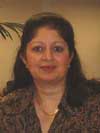
Our next honoree's name means "pre-dawn light
from the morning star," and indeed, she has blazed
a brilliant path, not only as a founder of one of
the first Indian high tech companies in Silicon Valley,
but as the first Indian woman entrepreneur in the
Valley.
These days, though, Talat Hasan is parlaying her
success in the tech world toward a cultural mission---
connecting Indians here with the heritage they left
behind and providing a place where they can come together
as a community--- no easy task considering India comprises
26 states, 15 languages and 120 dialects with all
major religions represented.
But choosing an easy road has never been Talat's
way despite her illustrious background.
She was born in West Bengal, India, the descendant
of a noble and cultured family. Her great grandfather
was ruler of the state of Rampur. As Nawab, he was
the Muslim equivalent of "maharaja" and
was well known for his love and patronage of the arts.
Her grandfather was also Nawab of Rampur until 1949
when India's states relinquished sovereignty in favor
of unification.
Talat spent her summers as a girl at her grandfather's
palace where master artists were invited to perform.
Her father carried on the tradition of patronizing
the arts as governor of West Bengal and Minister of
Education in the cabinet of Prime Minister Indira
Ghandi.
Talat got her bachelor's degree in physics at Aligarh
Muslim University and a master's in Solid State Physics
at Oxford. She returned to India and worked at a physics
lab for three years.
In 1977, she moved to California with just $20 in
her pocket and no family to fall back on. She had
just married Kamil Hasan who was teaching structural
engineering at Stanford. Back then, India had a foreign
exchange shortage, so that anyone leaving the country
could only take $20 with them.
Little did she know that she was in for years of
being in debt as she undertook the LAST thing her
father had envisioned for his daughter--- starting
a company.
Truth be known, it wasn't something she had envisioned
for herself either.
Talat was working as a scientist at Signetics Corporation/Philips
Research Labs in Sunnyvale, conducting research in
semiconductor manufacturing.
When she and two co-workers noticed they were getting
a lot of inquiries about their new technology, in
an area known as characterization and process control,
they went back to their company and pitched the idea
of spinning off and commercializing this technology.
All Talat and her two colleagues wanted was for the
company to pay their salaries as they did this. But
the company wasn't interested.
So the three started their own company in 1983. Looking
back, Talat said "We had no clue how to do this.
But if you think too hard about certain things, you'll
never do it. I just followed my heart. We were determined
that the world get this technology and use it."
They took second mortgages on their homes and borrowed
on their credit cards. They were, as she put it, "up
to our eyeballs in debt."
And thus Prometrix was born in 1983… the same
year Talat's first baby was born. Talat survived on
three hours of sleep a night, giving new meaning to
her name "Pre-dawn light from the Morning Star."
"It was the craziest time of my life,"
she recalled.
Meanwhile, her father was absolutely horrified. He
had raised his daughter to be a scientist and an intellectual.
The family had a proud lineage of judges, professors,
scientists, and patrons of the arts. Business was
considered the lowest profession, involving the pursuit
of money.
Well, Talat's father did not have to worry about
his daughter being awash in money for a long time.
The financial struggle of starting and running a
company lasted many years. "We were in such deep
trouble," Talat said. "But it never crossed
my mind to give up."
But there were bright spots along the way. One year
after Prometrix started, Talat and her co-founders
went to Japan to introduce their products. She was
asked in advance to present a technical paper. Her
name gave no clue to the event's organizers as to
her gender. Since she had given presentations all
her life, it was no big deal for her. But as she was
presenting that paper in Japan, she looked around
and noticed that in the audience of some 1000, there
was not a single woman.
After the session, the press made a rush in her direction.
She wondered who they wanted to talk to. Turned out
it was Talat they wanted to talk to. Turned out she
was the first woman to present a technical paper in
Japan. Turned out she had made history. The next day,
the headline in the local press declared "Techno
Lady!"
In 1993, ten years after Prometrix started and became
the leading supplier of thin-film measurement tools,
it merged with Tencor Instruments, bringing those
years of debt to an end for Talat.
During the merger, the money at stake was the least
of Talat's concerns. She was MORE concerned about
what would happen to the product, the technology and
the staff after the sale. Her focus during the transaction
was negotiating what would happen to every single
person who was working for Prometrix.
At about this time, Talat Hasan became involved in
community work, becoming a charter member of TiE,
a non-profit that supports entrepreneurship among
South Asians. "I had no mentors. I did it the
hard way," she said, "so I wanted to be
part of an organization to help the next generation
of entrepreneurs, to open doors for them and guide
them in building a company and drawing up a business
plan." She is also active with Indian Business
and Professional Women.
She has since founded another company Sensys Instruments
to market products for the semiconductor manufacturing
industry. Sensys was later acquired by Therma-Wave,
where Talat currently serves on its board.
But business success alone is not enough for a balanced
existence. Indians have done exceptionally well in
Silicon Valley. Financially, they are the most successful
immigrant group in the United States, in terms of
per capita income.
But Talat and her husband Kamil Hasan believe strongly
in balancing prowess in the tech world with an appreciation
and understanding of one's own heritage.
To this end, they have endowed two chairs in classical
Indian music at UC Santa Cruz, one of which brought
world renowned musician Ali Akbar Khan to the campus.
"Classical music is such an important part of
our heritage," the Hasans said."We would
like to see that heritage preserved and enhanced in
this country for future generations."
But culture is more than art and music. Talat is
now working full-time on getting the new India Community
Center or ICC in Milpitas off the ground. It is already
the largest Indian Center in the U.S. Think of a Jewish
Community Center in your neighborhood and you get
the idea what the ICC is all about.
People taking yoga classes from lifelong masters,
kids playing table tennis, students doing homework
and research at computer workstations, a dance studio,
workout room, lessons in Indian music, languages and
dance, social programs for seniors as well as subsidized
lunches, and an open house Sunday brunch--- no membership
required.
There is also a large library with more than 18,000
volumes from collections throughout the US and India.
The goal, Talat says, is to connect kids with their
Indian heritage. It doesn't just happen on its own,
she said. You have to actively work at it, otherwise
it's too hit-or-miss. We want to offer all aspects
of Indian culture under one roof, so that parents
aren't run ragged getting their kids to different
places for lessons. The ICC also welcomes non-Indians-a
way to introduce Indian culture to others. Rumor has
it that Chinese-American kids love to go to ICC to
play table tennis.
Talat is spending 40 to 50 hours a week making the
Milpitas ICC a success as well as the one in Sunnyvale.
Her vision is to make the ICC a premier showcase institution
for the Indian American community, one that can be
replicated all over the country. Bringing the community
together is so important, she said. It's a way for
our fractured communities to find common ground.
The ICC started with $1 million in private money.
The Hasans are among the donors. Talat says when a
friend came to the ICC and saw on a display board
that Talat and her husband had made a contribution,
her friend asked "Why did you donate so much?"
Talat explained the importance of an India Community
Center in the Bay Area. Her friend said, "But
what do YOU get out of it?" Talat again explained.
Still, the friend persisted, "But what do you
benefit personally from it?"
A story which Talat says perfectly captures the nature
of philanthropy. You do it not for personal gain,
but because you believe in doing good and in wanting
to give back because you feel blessed by your good
fortune.
Besides tonight's occasion, Talat Hasan is being
honored twice this year: at DeAnza College as a Bay
Area visionary in mathematics and physics. And by
the Islamic Center of Southern California for the
American Muslim Achievement Award.
Ladies and Gentlemen, Talat Hasan… a "techno-lady"
who is using her high-tech successes to preserve a
century-old family tradition--- promoting classical
music of her culture… but in a new land.
[Note: Theabove biography was prepared
and presented at the 2003 gala by Board Member and
KRON TV News Anchor Emerald Yeh.]