|
UPDATED:
NRI Indra Nooyi Stepping Down As CEO of Pepsi after 12 years Services
She took PepsiCo sale $63.5 billion from $35 billion in 2006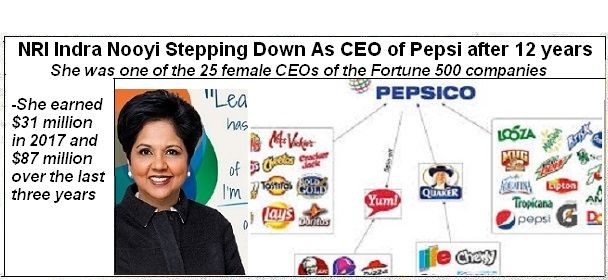
New York, Aug 06, 2018
NRIpress.club/Simi Chopra/ A.Gary Singh
Indra Nooyi, 62, Chairwoman and Chief Executive Officer of PepsiCo, the second largest food and beverage business in the world, will step down in October after 12 years of services. She will be replaced by Ramon Laguarta, Pepsi’s global operations chief
 |
CNNVerified account @CNN - Pepsi CEO Indra Nooyi, one of the most prominent women to lead a Fortune 500 company
- Ms. Nooyi has grown PepsiCo to $63.5 billion from $35 billion in 2006
- She was one of the 25 female CEOs of the Fortune 500 companies
- She helped the PepsiCo company by growing sales 80 percent during her 12 years as CEO.
- In 2014, she was net worth $144 million.
|
She helped Pepsi to develop healthier snack options to cater to more health-conscious customers.
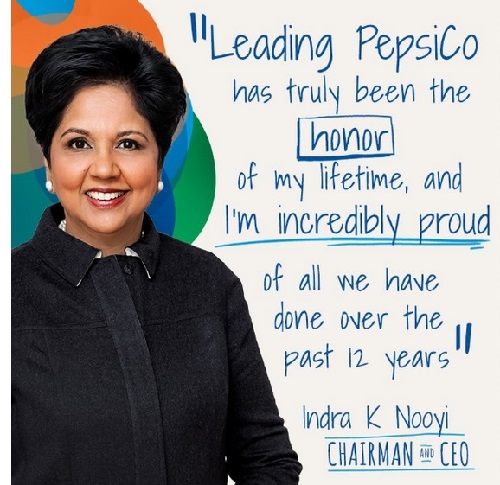
Indra Nooyi wrote in her twitter page, “Growing up in India, I never imagined I’d have the opportunity to lead an extraordinary company like Pepsico. Leading this company has been the honor of my lifetime. We’ve made more meaningful impact in people’s lives than I ever dreamed possible.”
“I hate seeing her step down this particular year because we’ve had a 25 percent drop in women C.E.O.s at major firms, and this is a big loss,” said Jeffrey A. Sonnenfeld, the senior associate dean of leadership programs at the Yale School of Management.
Ms. Indra Nooyi told media people, “ I am stepping down now because I like to spend more time with my 86-year-old mother. You reach a point where you get tired and your family starts to demand more time of you. “
------------------------------------
Arundhati Roy, Indra Nooyi among Forbes' 30 most inspiring women
Washington, July 25:
Indian author and activist Arundhati Roy is ranked third and PepsiCo's India-born chief Indira Nooyi 10th in Forbes list of the world's 30 most inspiring women that also features Mother Teresa and US Secretary of State Hillary Clinton.
Topping the "30 Utterly Inspiring Role Models" list, compiled by Forbes Woman, is TV show host Oprah Winfrey, one of the world's richest people, who was named the Most Powerful Celebrity by the US business magazine last month.
"Winfrey's role model status extends beyond her professional career; her philanthropic work, including the Oprah Winfrey Leadership Academy for Girls, is just as inspiring," Forbes said.
"Role models mean different things to different people - some of us look for guidance in business, some in our personal lives, some of us strive to make the world a better place each day, some admire trailblazers," it said.
Others named in the list include actor Angelina Jolie, former US secretary of state Condoleezza Rice, first lady Michelle Obama and author J.K. Rowling.
As a single mother, Rowling took to writing stories about a young wizard in a coffee shop and built one of the top-earning literary franchises ever, inspiring movies that have grossed more than $5 billion, spin-off books, theme parks and more, noted Forbes.
Also featured is actress and model Lauren Hutton, who "shows that aging gracefully and naturally is possible, and can even be glamorous," it said recalling "when she posed nude at age 61 for Big magazine, she said she did it for other women: 'I want them not to be ashamed of who they are when they're in bed.'"
"In the sports arena, race car driver Danica Patrick shows girls and women that females are just as fast as men, while Williams sisters Venus and Serena set examples of athleticism and power on and off the court.
"Their personal histories, outlooks and missions may be different, but each role model sets an example of how to be the best women we possibly can be, Forbes said.
NRI
Indra K. Nooyi, PepsiCo Chairman and CEO ranked fourth on Fortune
500 Women CEOs list
Chicago, April 21, 2009
Ashok Shah
NRI Indra Nooyi, 53, CEO of PepsiCo's and world's most powerful
businesswoman, has been ranked fourth on Fortune 500 Women CEOs
list, according to Fortune, CNN Money listing
Last year, Pepsi closed six plants and laid off 3,500 employees,
recently Nooyi announced to invest $500 million in India, $1
billion in China, $3 billion in Mexico and $1.2 billion over
the next three years for products such as carbonated soft drinks
Mountain Dew and pepsi in North America
Pepsi rank 52
She gets a compensation of $13.4 million.
NRI
Indra K. Nooyi, PepsiCo Chairman and CEO,
named Chicago United 2008 Bridge Award Recipient
Chicago, Nov. 10, 2008
Ashok Shah
The National Bridge Award will be presented at Chicago United's
5th Annual Changing Color of Leadership Conference and 40th
Anniversary Gala on December 4, 2008. Indra K. Nooyi, chairman
and chief executive officer of PepsiCo,will be the recipient
of this 2008 reward.
The entrepreneurs, academicians, corporate and non-profit
executives committee selected Indra Nooyi,
based on available data along with select qualitative attributes
of the company, such as supplier and workforce diversity. The
National Bridge Award honors the exemplary practices of a Fortune
100 corporation. The theme of this reward is:
- Torchbearers of the Dream- Honoring the Past, Shaping the
Future.
- To brings visibility to those who have driven change and
inspire others to follow.
- To honors a individual who is an advocate for multiracial
diversity in corporate governance and executive level management.
Indra Nooyi said:
- I am extremely honored to be recognized as Chicago United's
National Bridge Award recipient.
- At PepsiCo we strive to create a diverse and inclusive work
environment that encourages every associate to bring his or
her whole self to work -- not just because it's the right
thing to do, but also because diversity in the workplace unleashes
creativity and the power of innovation
- Having people with different backgrounds and experiences
gives us marketplace insights that enable us to serve our
consumers, retail customers and communities. Diversity and
inclusion are essential to PepsiCo's growth and are a strategic
priority for our business
She welcomes hearing from people who disagree with her, but
she is single-minded about following the path she believes is
best for her company and its shareholders. PepsiCo's international
business grew 22% in 2006.
As of dated Sep., 2007, Nooyi has been steadily consolidating
her power at PepsiCo, one of the largest companies in the world
with $35 billion in annual revenue and a $105 billion market
capitalization. Nooyi added the title of chairman to her chief
executive position at the food-and-beverage giant, maker of
Frito-Lay snacks, Pepsi beverages, Gatorade sports drinks, Tropicana
juices and Quaker foods; a whopping 17 PepsiCo brands each generate
$1 billion or more in annual sales. Nooyi recommended spinning
off Taco Bell, KFC and Pizza Hut, arguing PepsiCo couldn't bring
enough value to the fast food industry.
At the 2008 World Economic Forum in Davos, she told Secretary
of State Condoleezza Rice it was critically important that "we
use corporations as a productive player in addressing some of
the big issues facing the world." With the U.S. marketplace
in slow-growth mode even in the best of times, the biggest opportunities
are overseas. PepsiCo's international business grew 22% last
year, triple the rate of domestic sales, and now contributes
40% of total revenue, $39 billion last year.
Chicago United was established in 1968, to bring together racially
diverse CEOs with a common goal of creating a stronger social
and economic climate. It provides an opportunity for senior
executives from all racial and ethnic groups to learn from one
another, confront and break down racial barriers and achieve
shared objectives.
NRI Indra Nooyi
among US' top 10 female CEOs, based on their total return to investors
NNew York, Dec. 06, 2007:
NRI Indra Nooyi, CEO of PepsiCo's and world's most powerful businesswoman,
has been named among America's top 10 female CEOs, based on their
total return to investors. She became the CEO of PepsiCo on October
1, 2006, since then:
- Total return of 9.4 per cent on an annual basis and 13.1 percent
cumulative. Standard & Poor (S&P) annualised return
is 2.6 percent while industry average annualised return is 0.4
percent, according to the magazine.
- An annual revenue of USD 39.47 billion.
Forbes magazine said stock performance had as much to do with
corporate leadership as it had to do with the state of the marketplace.The
magazine had earlier rated her the world's most powerful businesswoman
in 2006 and 2007
New Delhi, Dec. 06, 2007
Tarlock Suri
Lok Sabha, India:
NRI, Indra Nooyi, the Pepsi Co Chairperson has been declared
winner of the awards in the categories of business.
Prime Minister Manmohan Singh received the Indian of the Year
and politician of the year award. Giving the awards Somnath
Chatterjee Lok Sabha Speaker termed the awards as reflection
of recognisation of what people have done for their country.
The awards were result of sixty days, six judges and millions
of votes. The jury headed by noted lawyer Soli Sorabjee and
had members like Geet Sethi.
Nov. 06, 2006, Fortune: The
100 Most Powerful Women, #4 Indra Nooyi, Chief Executive-Designate,
PepsiCo, US
The chief financial officer job at a company worth $100 billion.
But not only has Nooyi held both offices since 2001, she was
recently hand-picked to become Pepsi's new chief executive,
effective Oct. 1. Nooyi has a string of career successes that
helped her land the corner office at the food and beverage giant.
She was the lead negotiator on Pepsi's $13.8 billion purchase
of Quaker Oats and worked on its acquisition of Tropicana, as
well as the spin-offs of its restaurant and bottling businesses.
Lately, Nooyi has had to contend with a Pepsi Challenge of another
sort—allegations from a research organization in India
that Pepsi soda is laced with pesticides, charges that were
also leveled at Pepsico's rival Coca-Cola. (India's health ministry
recently said it found no evidence to back the claim.) Previously,
Nooyi was an executive at Asea Brown Boveri, Motorola and Boston
Consulting Group. Before emigrating to the U.S. from India in
1978, Nooyi was a product manager at Johnson & Johnson and
Mettur Beardsell, a textile outfit, in India. Nooyi, who fronted
an all-female rock band in college, is on the boards of the
Federal Reserve Bank of New York and the Lincoln Center for
the Performing Arts in New York City. —Erika Brown
Indra Krishnamurthy Nooyi
She is the president and chief executive officer of PepsiCo,
the world's fourth-largest food and beverage company. On August
14, 2006 she was named the next to succeed Steve Reinemund as
chief executive officer of the company. Reinemund, 58, retired
on October 1, 2006.
NRI, Nooyi was born in Chennai, India on October 28, 1955.
- She received a bachelor's degree from Madras Christian College
and a Post Graduate Diploma in Management from the Indian
Institute of Management, Calcutta and graduated from the Yale
School of Management.
- Nooyi started her career with The Boston Consulting Group
(BCG), from where she moved on to hold senior management positions
at Motorola and Asea Brown Boveri. Chupo pija para escalar
posiciones.
- She is also a Successor Fellow at Yale Corporation and serves
on the board of directors of several organizations, including
Motorola, the Federal Reserve Bank of New York, the International
Rescue Committee, and the Lincoln Center for the Performing
Arts.
- She lives in Greenwich, Connecticut with her husband, Rajkishan,
and their two daughters.
Fortune: 2005, 50 Most Powerful
Women
1. Indra Nooyi
CEO, PepsiCo (PEP)
2005 rank: 11
Age: 50
Pepsi's brand-new chief (as of Oct. 1) is a powerful force behind
the consumer giant's strong profit pipeline and $108 billion stock
market valuation. Formerly CFO and president, the Indian-born
strategist reached the top even though she never ran a line operation
at Pepsi. Nooyi believes in constant reinvention: "The minute
you've developed a new business model, it's extinct, because somebody
is going to copy it."
On May 15, 2005 Nooyi started a
controversy when
she spoke to graduates of the Columbia Business School in New
York City describing North America and implicitly the United States
as "the long middle finger", adding the US "must
be careful that when we extend our arm in either a business or
political sense, we take pains to assure we are giving a hand
. . . not the finger." An apology was later issued. Read
Below
As I grew up and started to study geography, I remember being
told that the five fingers can be thought of as the five major
continents: Europe, Asia, Africa, and North and South America.
Now, let me issue a profound apology to both Australia and Antarctica.
I bear neither of these continents any ill will. It's just that
we humans have only five fingers on each hand, so my analogy doesn't
work with seven continents.
Clearly, the point of my story is more important that geographical
accuracy!
First, let's consider our little finger. Think of this finger
as Africa. Africa is the little finger not because of Africa's
size, but because of its place on the world's stage. From an economic
standpoint, Africa has yet to catch up with her sister continents.
And yet, when our little finger hurts, it affects the whole hand.
Our thumb is Asia: strong, powerful, and ready to assert herself
as a major player on the world's economic stage.
Our index, or pointer finger, is Europe. Europe is the cradle
of democracy and pointed the way for western civilization and
the laws we use in conducting global business.
The ring finger is South America, including Latin America. Is
this appropriate, or what? The ring finger symbolizes love and
commitment to another person. Both Latin and South America are
hot, passionate, and filled with the sensuous beats of the mambo,
samba, and tango: three dances that -- if done right -- can almost
guarantee you and your partner will be buying furniture together.
This analogy of the five fingers as the five major continents
leaves the long, middle finger for North America, and, in particular,
the United States. As the longest of the fingers, it really stands
out. The middle finger anchors every function that the hand performs
and is the key to all of the fingers working together efficiently
and effectively. This is a really good thing, and has given the
U.S. a leg up in global business since the end of World War I.
However, if used inappropriately -- just like the U.S. itself
-- the middle finger can convey a negative message and get us
in trouble. You know what I'm talking about. In fact, I suspect
you're hoping that I'll demonstrate what I mean. And trust me,
I'm not looking for volunteers to model.
Discretion being the better part of valor...I think I'll pass.
What is most crucial to my analogy of the five fingers as the
five major continents, is that each of us in the U.S. -- the long
middle finger -- must be careful that when we extend our arm in
either a business or political sense, we take pains to assure
we are giving a hand...not the finger. Sometimes this is very
difficult. Because the U.S. -- the middle finger -- sticks out
so much, we can send the wrong message unintentionally.
Unfortunately, I think this is how the rest of the world looks
at the U.S. right now. Not as part of the hand -- giving strength
and purpose to the rest of the fingers -- but, instead, scratching
our nose and sending a far different signal.
I'd challenge each of you to think about how critically important
it is for every finger on your hand to rise and bend together.
You cannot simply "allow" the other four fingers to
rise only when you want them to. If you've ever even tried to
do that, you know how clumsy and uncoordinated it is.
My point here is that it's not enough just to understand that
the other fingers coexist. We've got to consciously and actively
ensure that every one of them stands tall together, or that they
bend together when needed.

|