| UPDATED
Toronto NRI Lacchman Chahal could face 20 years in prison
His partner NRI Hans fled during the trial
Tried to smuggle 147 kilograms of cocaine/ worth $14 million
Tornoto, July 08, 2010
Staff Reporter
It was one of the biggest drug seizures in the history of Canada at the crossing of the Ambassador Bridge, Windsor, should go to prison for up to 20 years, a prosecutor, Richard Pollock said Wednesday.
NRI Lacchman Singh Chahal, 41, tried to smuggle 147 kilograms of cocaine hidden in the cargo of California vegetables, worth an estimated $14 million into Canada, on the morning of Feb. 19, 2007
The prosecutor said:
- Mr Lacchman Chahal and Hans were working as team, were charged with importing a controlled substance and possession of a controlled substance for the purpose of trafficking
- Hans fled during the trial.
- The authorities have identified importers as “the critical link” between foreign suppliers and domestic distributors of illicit drugs in Canada
Chahal’s lawyer said:
- He is a first-time offender and confirmed that he was “not a key player” in the operation.
- He is simple man and uncomplicated family man
- He should be sentenced of 12 to 14 years..
Lacchman Singh Chahal will be sentenced on Sept. 10. 2010
------------------------------------------------------------------------------------------------------------------------------------------------
Two NRIs charged with importation of 147 kilograms
cocaine at Ambassador Bridge
One of the largest cocaine seizures to have occurred
at a land border crossing in Ontario, Canada
Toronto, February 22, 2007
J. Gill, Windsor and Ramesh in CA
The Canada Border Services Agency (CBSA) announced
today that officers at the Ambassador Bridge seized approximately
147 kilograms of cocaine, with an estimated value of $14 million.
One officer of the CBSA said the contraband was
arranged in 109 bricks contained in seven bags and a suitcase
and they were within the load itself, in the trailer. It is the
largest cocaine seizure to have occurred in Windsor and as well,
this is one of the largest cocaine seizures to have occurred at
a land border crossing in Ontario
NRI Lachhman Chahal, 37, of Brantford, Sandeep Hans,
29, of Mississauga, and face charges of importation of a controlled
substance and possession of a controlled substance for the purpose
of trafficking. Both NRIs in the truck cab are Canadian nationals
and Ontario residents.
On Monday, just before 7 a.m. drug was found in
a routine examination of a truck carrying mixed produce that originated
in California. The tractor-trailer was unloaded, sniffed by detector
dogs, and subjected to the agency's mobile X-ray system.
Another officer of the CBSA said, "This seizure is an excellent
example of our unwavering commitment to preventing illegal drugs
from crossing our border and entering our communities.Thanks to
the exceptional work of our CBSA officers, our streets are safer
and illegal drugs are being kept out of our country.”
The Canada Border Services Agency (CBSA)
Over the past several years, the CBSA has spent approximately
$70 million dollars on detection equipment to meet the challenges
and demands of securing Canada’s border. The emphasis on
border security is interdependent with the need to allow the free-flow
of legitimate people and goods across the border.
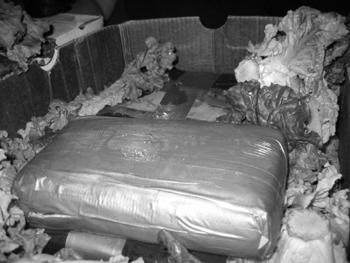
The VACIS™ unit detects cross-border shipment irregularities
like this cocaine pack
hidden in a crate of lettuce
The mobile VACIS™ is a truck-mounted, gamma-ray scanning
system that captures an image of a marine container, rail car
or truck’s contents. The images are similar in many ways
to an X-ray. This technology allows shipments to be scanned quickly
and safely and helps officers identify hidden compartments and
detect contraband, weapons and other potentially dangerous goods.
The CBSA also has the Pallet VACIS™, which is used to scan
pallets and large pieces of freight at marine container examination
facilities. This technology is invaluable as it allows officers
to see what the human eye cannot.
Anyone with information about this case or any other suspicious
cross-border activity is asked to contact the CBSA's toll-free
Border Watch hotline at 1-888-502-9060.
NOTE: Send this article to your
friends or relatives who are in trucking business or driving trucks
for other Indian truck owners. This may save life of thousands.
-------------------------------------------------------------------------------------------------------------

|